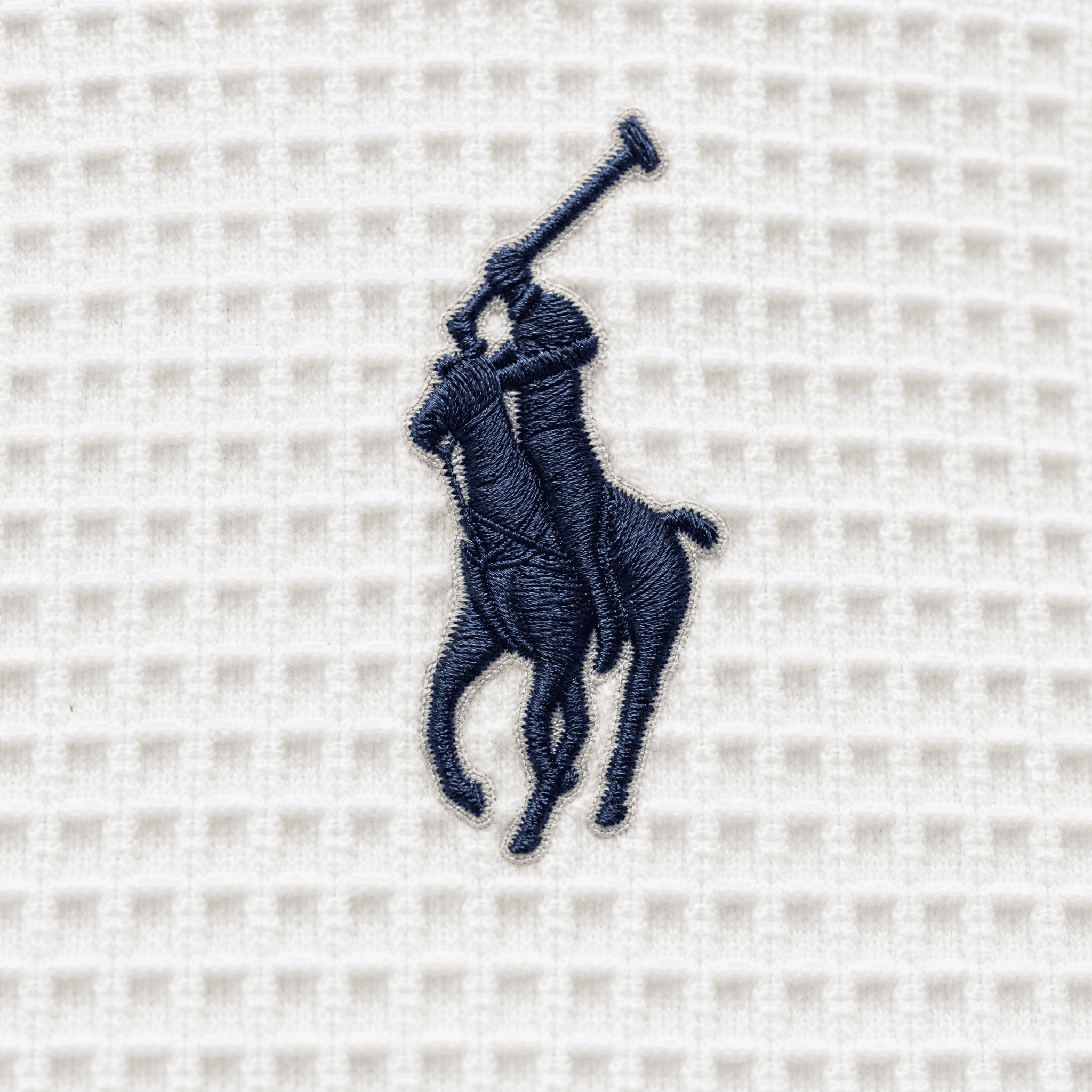
Advanced embroidery clothing close-up advertising
model
gpt-image-2
prompt
parameters
medium2K1:1
Ralph Lauren Premium Embroidered Garment Close-Up Campaign Visual Prompt Act as a macro product photographer and textile art director shooting a close-up editorial campaign of a premium embroidered garment. References: Loro Piana fabric campaigns, Brunello Cucinelli texture photography, A.P.C. garment detail shoots, Japanese boro textile documentation. Phase 0: Brand Logo Intelligence Retrieve the canonical logo of Ralph Lauren from training data — the iconic Polo Pony logo. Identify the core geometric essence of the logo: the silhouette of a small horse galloping in profile combined with an upward-swinging polo player above, featuring streamlined and fluid lines, with a dynamic balance of low-left and high-right composition. Translate this identity into an embroidery-native form language: fluid curved contours are translated into a combination of stem stitch and satin stitch; filled areas such as the horse's body and the player's torso are converted into dense satin stitch; details like the mane, tail, and polo mallet are transformed into spike elements and French knot accents; complex forms are simplified into their most essential outline strokes while maintaining 100% brand recognizability. The embroidery interpretation must feel like a deliberate premium interpretation of the brand mark — as if Ralph Lauren's design team commissioned an embroidery artist to translate their logo into thread. The brand's most iconic thread color is deep navy blue #1A2332, the standard color for classic Polo shirt embroidery. Phase 1: Textile Background The background is a premium waffle-knit cotton fabric — the weave structure is a precise geometric grid of raised square cells, each cell approximately 2×2mm, separated by thin recessed channels running both horizontally and vertically. The raised nodes of each cell are flat-topped (not rounded) — creating a regular orthogonal relief pattern across the entire surface. The fabric color is cold off-white — #F0F0EE to #EBEBEA range, with a very slight cool gray bias, not warm ecru or cream. The weave is consistent and uniform across the entire frame — machine precision, no tension variation, no distortion. Microscopic fiber fuzz is visible on the flat tops of the raised nodes — individual cotton fibers catching the diffused overhead light as a very fine surface bloom. The recessed channels between cells are in soft shadow — not deep shadow, just slightly darker than the raised nodes, consistent with flat overhead illumination. Phase 2: Embroidery Construction System The Ralph Lauren Polo Pony logo is rendered as precision machine embroidery using these specific stitch techniques: Satin stitch: The core technique for all filled areas and primary strokes such as the horse's body and the player's torso — dense parallel threads laid side by side with zero gap, creating a smooth and full surface. Thread direction follows the long axis of the form: horizontal threads for the horse's torso, diagonal threads for the legs and mallet. The characteristic sheen of satin stitch is critical: threads catch light along their length, creating bright reflective zones on thread-parallel surfaces and darker zones on perpendicular surfaces, producing a directional shimmer. Stem stitch / Outline stitch: Used for curved linear elements such as the pony's outer contour, player's silhouette, and mane/tail — thin continuous overlapping thread segments that turn naturally and flexibly along curves, creating crisp and precise lines. French knots: Small circular dot elements such as the pony's eye and the end of the mallet are rendered as tightly wound thread knots — each knot has a visible spiral wind pattern at macro distance. Spike elements: The tips of the mane and tail are presented as long tapering needle-like forms, executed in satin stitch that tapers from full width to a single thread point — gradual and precise, ending in a razor-sharp thread tip. Edge treatment: Every embroidered element has a thin visible backing outline — 1 to 2 thread widths of the base fabric visible between the embroidery and the surrounding textile. This underlay/backing edge is slightly lighter than the main embroidery thread — it outlines every form and confirms the physical layering of embroidery over fabric. Physical relief: The embroidery sits 1 to 3mm above the fabric surface — confirmed by a very subtle shadow halo directly underneath each element. The shadow is symmetrical around the embroidery perimeter, soft-edged, 1 to 2mm wide — consistent with flat overhead illumination, not directional raking light. Phase 3: Thread Material Primary thread color: Deep navy blue #1A2332 as determined in Phase 0. The thread material is high-twist mercerized cotton embroidery thread — high sheen, smooth filament surface. The thread color is never flat — it shifts in value along its length based on light angle. Directly lit zones approach a lighter, brighter navy, while shadow zones approach a deeper, more saturated navy. The overall embroidery reads as one unified color but contains a full tonal range within that color family. Secondary thread: The backing/underlay edge thread is 2 to 3 shades lighter than the primary thread — a light beige-gray, creating the characteristic light outline visible around all embroidered elements. Phase 4: Composition & Camera Camera body: Canon EOS R5 or Nikon Z8 — full frame, ≥45 megapixel for fabric texture resolution. Lens: Canon RF 100mm f/2.8L Macro IS USM or Nikon Z MC 105mm f/2.8 VR S — used at moderate close-up distance, not at maximum 1:1 magnification. Focus distance: 40–55cm — the embroidery fills approximately 30–40% of the frame height, leaving generous fabric context on all sides. This is a moderate close-up, not extreme macro — the full embroidery composition is visible with substantial textile surround. Aperture: f/8 to f/11 — deep depth of field, the entire embroidery and all surrounding fabric texture are in crisp simultaneous focus from corner to corner. No visible bokeh anywhere in the frame. Shutter speed: 1/200s (continuous light source). ISO: 100 — base ISO, zero noise, maximum tonal resolution in the subtle gray shadows of the waffle recesses. White balance: 5600K — neutral daylight, renders the cold off-white fabric accurately without warm/cool shift. Exposure: Slightly bright ETTR (Expose To The Right) — the off-white fabric renders as a luminous near-white, embroidery thread reads as deep rich dark against the bright ground. Aspect ratio: 4:5 portrait. Camera angle: Perpendicular to fabric plane — zero perspective distortion, embroidery geometry rendered faithfully. Phase 5: Lighting Primary light: Large diffused overhead source — a 120×120cm softbox or diffusion panel positioned directly above the fabric at 60–80cm distance. The light is as close to flat and directionless as possible. No raking angle — the light comes from directly above at 85–90° to the fabric plane. This flat overhead lighting creates: uniform brightness across the entire fabric field with no hot spots or falloff; very short soft shadows in the recessed channels of the waffle grid — 1–2mm wide, soft-edged, falling straight down; soft symmetrical micro-shadow halo directly beneath the embroidery — the 1–3mm relief creates a subtle darker zone immediately surrounding the embroidery perimeter, equal on all sides; no directional shadow — the shadow is not cast to one side. Secondary light: None. No fill, no rim, no accent. The single large overhead diffused source is the complete lighting setup. Overall mood: Clinical, precise, bright — consistent with product documentation or high-end textile editorial photography where the subject must be seen with maximum clarity and zero atmospheric distraction. Phase 6: Tech Specs Renderer: Octane Render or Redshift with fiber/textile displacement geometry. Thread geometry: Actual 3D cylindrical thread strands — each thread strand is a real geometric object casting real shadows on adjacent threads, not texture maps. Fabric weave: Real geometric displacement mesh for waffle structure — not normal map. Ray tracing: On — for accurate micro-shadow casting between individual thread strands and between embroidery and fabric surface. Subsurface scattering: Subtle on thread material — mercerized cotton has slight translucency. Depth of field: Physically accurate — f/8 to f/11 at 100mm at 40–55cm focus distance, full frame sharp corner to corner. Anti-aliasing: Maximum. Sampling: Minimum 2048 samples — zero noise in shadow zones, full tonal resolution in the off-white fabric field. Output feel: This image should be indistinguishable from a photograph taken with a Canon 100mm macro in a textile documentation studio. The viewer must feel the urge to touch the fabric.