Love this? Log in to make your own version.
Cinematic Butterfly-to-Human Metamorphosis
- Video
- 3:4
- 834 × 1112
- 13.0s
Generation recipe
- model
- Seedance 2.5
- resolution
- 834x1112
- duration
- 13s
Prompt
Live-action film realism, suspense-driven long take. Real skin, fine hair strands, heavy fabric texture, and natural insect detail. Subtle film grain, soft highlight roll-off, deep clean black levels. Avoid over-sharpening, plastic look, and cheap CG feel. Entire sequence uses war-documentary-style shoulder-mounted handheld cinematography. The camera carries real physical weight: subtle breathing bob, irregular weight shifts, micro frame corrections, with motion that has inertia and damping. Restrained and tense, always keeping a clear compositional order — no violent whip pans. The camera operator stays fixed in place, one continuous take, no push-in toward the butterfly, no zoom. Use a mid-telephoto cine lens for spatial compression, shooting down the depth of the corridor, so the distant butterfly remains identifiable while preserving a clear sense of distance between it and the lens. Focus naturally racks with the subject, finally settling on the heroine’s eyes in close range. A long, enclosed corridor. Doors on both sides and the ceiling form strong leading lines into depth. Ceiling lamps are spaced apart, each casting its own independent pool of light on walls and floor — bright zones alternating with deep dark gaps, extending into the distance. Cool-white light with a faint cyan tint; walls stay low-saturation grey-blue. The butterfly’s blue and the orange-gold of its eyespots form a precise warm-cool contrast. Floor has restrained soft reflections; lamp highlights do not clip; shadow detail is built by real light sources only — no uniform ambient fill. When a lamp is on, the overhead-side corridor light creates directional light/shadow on the subject. When a lamp goes out, its light zone and reflections genuinely recede. After the last lamp is extinguished, the entire space must be absolute black. Cinematic light logic must never be used as an excuse to retain rim light, blue underglow, or extra fill light. 【Butterfly & Eyespot Patterns】 There is only one subject throughout: a single blue butterfly that continuously transforms into the same young woman. The butterfly has a slender body, natural antennae, two pairs of broad, thin wings moving in coordination, with real wing veins, dense scale powder, and soft wing edges. It stays within a small zone in the mid-to-far section of the corridor, fluttering pulse by pulse — never flying toward the lens. Each wing carries one primary eyespot pattern: a dark center surrounded by multiple layers of fine orange concentric rings. The pattern always exists on the wing surface, bending and folding with the wing, shifting with perspective. Only at certain fully-spread angles do both eye-like patterns become briefly visible; when wings fold or turn sideways, they are naturally occluded. The pattern is not an icon floating above the wing, and not a 3D eyeball. 【0:00–0:05 | Distant Wing Flapping】 The butterfly flutters naturally in the mid-to-far corridor: wings lift and close, then beat downward and spread, driving slight vertical bobbing, with small lateral drifts and directional corrections. It does not approach the camera. Wingbeats are light, continuous, with rhythmic variation — wing root driving the wingtip, thin wings flexing subtly, wing edges carrying natural motion blur. No slow-motion wing-spreading, no mechanical hovering. Overhead lamps at varying angles graze the blue wing surface; scale-powder sheen flickers briefly with each beat. The orange concentric rings on both sides sometimes show together, sometimes only one side is visible, then vanish again as wings fold. The camera captures this with micro handheld movement; background lights softly defocused, yet the lamp arrangement, light/dark zones, and corridor depth remain readable. 【0:05–0:07.5 | Light Zones Extinguishing in Sequence】 The corridor lighting begins to malfunction. The farthest lamp dims first, then the next, then the next — extinguishing slowly from far to near along the depth axis. Each lamp has a brief brightness decay, with a clear time gap between adjacent lamps. The decay applies to the whole space: the lit wall area darkens, door-frame highlights disappear, floor reflections gradually fade, darkness advancing toward the camera zone by zone. Not a uniform global dimming of the frame. The butterfly keeps fluttering in the distance, briefly lit by lamps still on. The blue wing surface gradually becomes invisible; the orange rings intermittently reveal during wing spreads. When the last lamp goes out, the space turns absolute black. Walls, floor, door frames, ceiling lamps, wing surfaces, and the butterfly’s body all vanish. No emergency light, no rim light, no air glow, no residual reflection. Exposure must not auto-lift; do not turn black into grey. 【0:07.5–0:10 | Seamless Transition in Pure Black】 Only two faint orange concentric-ring patterns remain, like the afterglow of a glow-in-the-dark coating in darkness — low luminance, soft, tiny, barely readable ring lines. No obvious halo, no illumination of surroundings, no neon or flame quality. At first, the two glows still shift angle slightly with the last few wingbeats and bob gently, then the motion naturally slows. It is always the same pair of glows — no extinguish-and-reappear, no overlaying of a second pair of eyes. Using pure black to hide the body and spatial-distance change, the butterfly’s eyespot rings continuously become the heroine’s irises. The color, ring structure, and on-screen trajectory of the two glows remain consistent; spacing and size adjust only with smooth, restrained interpolation — no sudden jumps, no exaggerated enlargement, no iris-like zoom toward the lens. The heroine has already completed her transformation in the dark and stands before the camera, but at this point her sclera, eyelids, nose bridge, face, hair, and body are all invisible. The frame contains only pure black and two glow-in-the-dark orange rings. Subtle handheld camera motion continues throughout; the glows respond to the same camera movement naturally, not pinned flat to the screen. Focus naturally transfers to the near distance under the black cover, preparing a clean handoff for the eyes once lights return — no visible hunting focus. 【0:10 | Lights-On Reveal】 All corridor lights snap back to normal illumination simultaneously. Not a white flash, not a transparent face gradually appearing — real lights instantly reveal the heroine who is already standing in front of the camera. Heroine faces the lens directly, medium close-up from chest up. The two glows from before precisely become the orange concentric-ring irises of her eyes after lights-on — position, shape, and motion trajectory are continuous. Only at this moment does the viewer realize the distant butterfly has become the nearby woman. An overhead-side lamp casts a directional cinematic key light on her: forehead, nose bridge, one cheekbone, and the edge of the upper lip catch soft highlights; the other side of her face falls into deep, natural shadow, retaining necessary skin-tone detail. Lamps behind her create a narrow, restrained edge glow on hair strands and shoulder line, separating her from the deep corridor. Background restores the alternating bright/dark zones, emphasizing depth. Skin tone stays natural, with a subtle color-temperature contrast against the cool cyan-grey background — do not tint her whole face blue. Eyes are crisp: black round pupils, surrounded by multiple fine orange and orange-gold concentric rings; sclera, eyelashes, and corneal reflections are real and natural. The rings retain a restrained glow, fused with normal illumination — not lighting up the whole face, not blurring into two light orbs. The butterfly has completely disappeared. 【0:10–0:13 | Human Cinematic Portrait】 The full human form holds for ~3 seconds. The heroine looks straight into the lens, lips naturally closed, with only micro-expressions, subtle breathing, and slight hair movement. No walking, no head turn, no further transformation. Camera holds the shoulder-mounted handheld stance, subtle breathing bob continuing throughout. Framing stays stable, focus locked on the eyes. Facial light/shadow, natural skin texture, hair layers, and fabric folds are clearly visible. Background moderately defocused, preserving the depth rhythm of the corridor light zones. Ends on the heroine’s close-up with clearly readable orange ring-patterned irises — not frozen into a photo, no early blackout, no fade-out. 【Sound & Continuity】 Low ambient corridor room tone, faint electrical hum as each lamp decays, a brief power-surge click when all lights snap back, then only faint breathing remains. The distant butterfly has no exaggerated wing-flap sound. No background music, no dialogue, no subtitles. Throughout: live-action cinematic quality, shoulder-mounted handheld, single continuous take. Butterfly stays distant, fluttering naturally; eyespot rings always present but appearing/disappearing with wing spreads. After lamps extinguish in sequence, pure black only, with just two glow-in-the-dark faint orange concentric rings. No human form revealed early in the dark. At 0:10, lights snap back globally; the heroine is already in front of the lens, the two wing eyespots seamlessly becoming her two eyes. Final full-form hold ~3 seconds. No smoke, no particle explosion, no white-flash transition.

pet poster
Cinematic photograph

brand poster
micro- drama
Global Brand Campaign Poster

Pilates studio landing page UI design

Vertical Outdoor Rock Climbing Competition Poster
Micro-drama
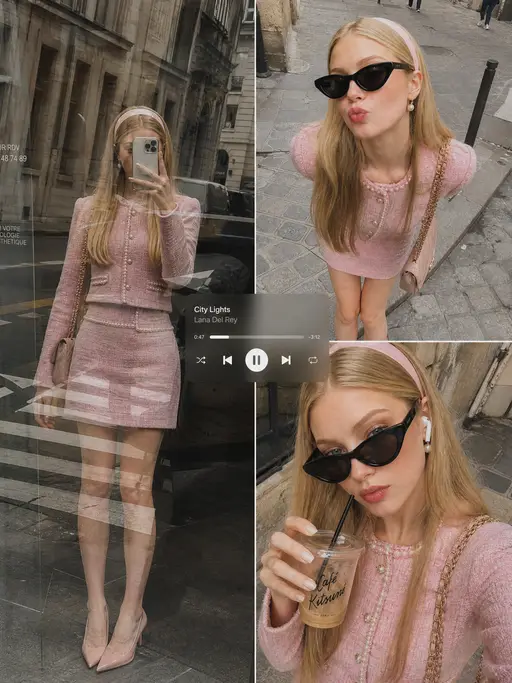
Instagram-style candid shot
2000s American teen-campus vignette
Daily routine
Editorial portrait
Character poster
Micro-drama sequence
Ancient Egyptian comedy video